Skip to content
Shaft failure often stems from overlooked specs and misaligned process choices.
A shaft is a precision component that transmits torque, supports rotating parts, maintains alignment, and absorbs bending stress—essential in engines, robots, and industrial machines.
In this guide, I’ll walk through shaft types, manufacturing processes, materials, tolerances, surface finishes, sourcing tips, and why Onlyindustries is your ideal shaft partner.
What Is a Shaft?
One overlooked tolerance or material choice in a shaft can trigger system-wide downtime.
A shaft is a rotating or stationary component used to transfer torque, support other components, and maintain alignment in mechanical assemblies. These parts are typically round and can include features such as keyways, splines, threads, or shoulders to interface with other mechanical elements.

Dive Deeper
Let me walk you through why shafts are so critical:
Core Functions of a Shaft
- Torque Transmission: Whether connecting a motor to a gearbox or driving a wheel, the shaft must reliably carry torque without twisting or shearing.
- Support of Rotating Components: Gears, flywheels, pulleys, and couplings often rely on shafts for concentric rotation and structural support.
- Precision Alignment: Shafts are essential in keeping mating parts aligned within tight concentricity and runout tolerances. This reduces vibration and wear.
- Absorbing Stresses: Bending from side loads or axial forces—along with torsional loads—requires that shafts maintain mechanical integrity under real-world operating conditions.
Common Shaft Design Features
| Feature | Purpose |
|---|---|
| Keyway | Locks a gear or pulley in place |
| Splines | Allows high-torque transfer via interlocking teeth |
| Shoulders | Control axial positioning of mounted parts |
| Threads | Enable fastening of nuts or other components |
| Tapers | Ensure self-centering fit and high contact pressure |
From low-speed axles to high-speed spindle shafts, each design choice affects long-term reliability, power efficiency, and manufacturing cost. That’s why it’s essential to understand what kind of shaft your application demands before jumping into production.
Shaft Types & Applications
Using the wrong type of shaft in your application can lead to premature wear or complete system failure.
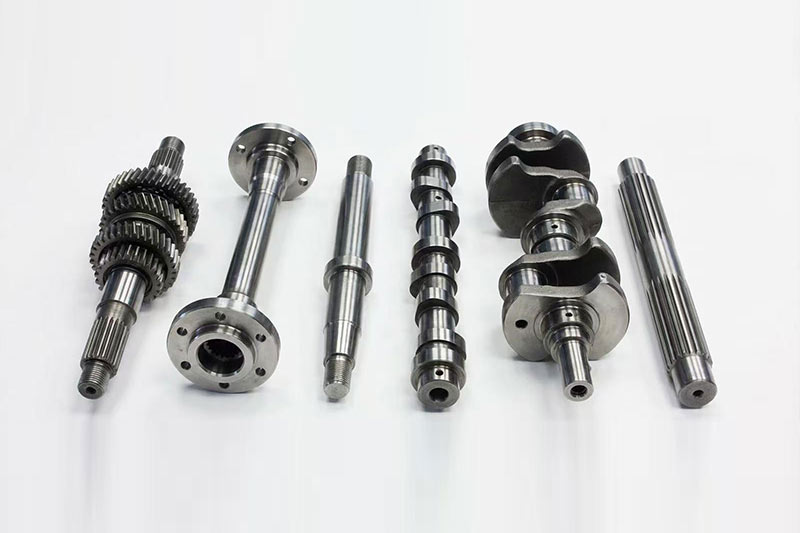
Different shafts are designed for specific roles—from torque transmission to rotational support. Understanding the types of shafts and where they excel helps you choose the right one for your engineering needs.
Dive Deeper
Let’s break down the most common shaft types and their ideal applications, so you can align function with form:
| Shaft Type | Description | Common Applications |
|---|---|---|
| Transmission Shaft | Transfers power between two rotating components. Must be torsionally stiff and often includes keyways or splines. | Gearboxes, automotive drivelines, conveyors |
| Axle Shaft | Supports weight while allowing rotation. Designed for strength and endurance under combined loading. | Vehicles, trailers, industrial carts |
| Spindle Shaft | Used in high-speed applications where runout control is critical. Often precision-ground and balanced. | CNC machine spindles, high-speed routers |
| Camshaft | Uses eccentric lobes to control valve or pump timing. Requires precise profile machining. | Internal combustion engines, hydraulic pumps |
| Crankshaft | Converts reciprocating motion into rotational motion. High strength and fatigue resistance are essential. | Engines, compressors, manual pumps |
| Splined Shaft | Features interlocking teeth (splines) that engage with a mating hub to transfer torque with minimal play. | Actuators, gear couplings, aerospace mechanisms |
| Flexible Shaft | Composed of tightly wound wire coils to allow bending while transmitting torque. Enables motion through curves or non-linear paths. | Dental tools, flexible rotary tools, robotics |
Each shaft type brings unique mechanical advantages—knowing when to use which makes the difference between a robust system and a costly failure. From load type to operating speed and alignment requirements, the right shaft ensures long-term success and simplified maintenance.
What Manufacturing Processes Are Used for Shafts?
The fabrication method you choose shapes precision, durability, and production cost.
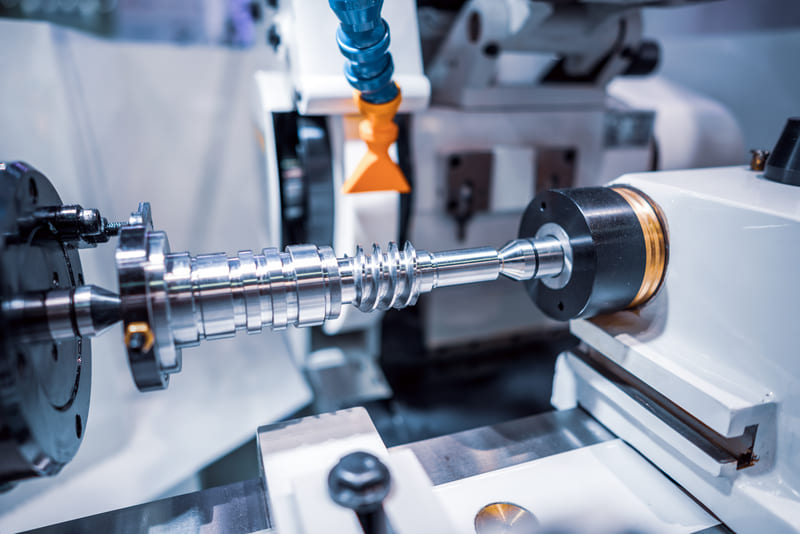
Manufacturing shafts involves a mix of turning, milling, grinding, spline forming, threading, and heat treatment—each selected based on geometry, material, and performance requirements.

Dive Deeper
- CNC Turning: Used for cylindrical features, achieving tight concentricity and dimensional accuracy (±0.005 mm). Bases shafts are shaped in lathes with high-repeatability control.
- CNC Milling: Applies flats, keyways, slots, threads, or multi-axis forms. Essential for functional interfaces and features that support mating components.
- Grinding: Polishes critical surfaces (journals, bearings) to finishes between Ra 0.2–0.4 µm. Used for precision fit and minimal runout.
- Spline Hobbing/Broaching: Hobbing cuts external spline teeth efficiently in moderate volumes. Broaching removes material to form internal splines in a single pass, minimizing backlash.
- Thread Rolling/Cutting: Thread rolling forms strong, work-hardened threads with no chips. Cutting creates precise thread profiles on shafts requiring standard nut engagement.
- Heat Treatment: Techniques like induction hardening, carburizing, or nitriding enhance surface hardness and fatigue life. Core properties remain ductile, while external layers resist wear.
Often, multiple processes are combined—e.g., a 4140 alloy shaft is turned to near-net shape, milled for keyways, ground for journals, heat-treated, and then re-ground to final finish. Understanding this sequence helps you design for manufacturability and performance.
What Are the Best Material Choices for Shafts?
Material selection shapes a shaft’s strength, durability, corrosion resistance, and cost.
Selecting the right shaft material is about balancing performance needs with production feasibility. From affordable carbon steel to lightweight titanium, each option has trade-offs in strength, machinability, and application suitability.

Dive Deeper
| Material | Characteristics | Ideal Applications |
|---|---|---|
| Carbon Steel (1045) | Affordable and moderately strong; good balance of machinability and toughness. | General-purpose shafts where heavy corrosion protection isn’t needed. |
| Alloy Steel (4140, 4340) | High tensile strength and fatigue resistance; excellent for heat treatment. | Industrial drives, transmission shafts, high-load components. |
| Stainless Steel (304, 316, 17‑4PH) | Corrosion-resistant and potentially biocompatible; 17‑4PH adds significant strength. | Food, medical, and marine environments where hygiene and corrosion are critical. |
| Aluminum (6061, 7075) | Lightweight and easy to machine; 7075 offers near-aluminum alloy strength. | Light-duty, weight-sensitive applications like UAVs and robotic arms. |
| Titanium (Ti‑6Al‑4V) | Exceptional strength-to-weight ratio and corrosion resistance; costly and harder to machine. | Aerospace, high-performance automotive systems, medical instruments. |
For shafts under heavy cyclic loading, I recommend alloy steel with induction hardening. For corrosion-exposed parts, stainless steel variants like 17‑4PH are ideal. Lightweight aluminum shafts serve well in less intense environments—but when strength matters, titanium is the premium choice. Aligning material to your operating conditions ensures both performance and manufacturing efficiency.
How Do Tolerances & Quality Standards Impact Shaft Performance?
Even minor deviations can cause vibrations or failure in shaft assemblies.
Maintaining precise tolerances and adhering to rigorous quality standards ensures that shafts perform reliably under dynamic loads and integrate seamlessly into complex assemblies. It’s essential for minimizing wear, vibration, and mechanical failure.

Dive Deeper
Why Tolerance Matters in Custom Shafts
Precision tolerances govern how closely a shaft matches its design intent. This includes dimensions like diameter, straightness, and roundness. For high-speed or high-load applications, even a 0.01 mm discrepancy can compromise system efficiency or safety.
Key Tolerances to Monitor
- Runout (≤ 0.01 mm): Measures wobble when rotating; critical for high-speed shafts.
- Concentricity (≤ 0.005 mm): Ensures rotating sections share a common axis; vital for balanced rotation.
- Diameter Tolerance (±0.01–0.05 mm): Depends on shaft function and fit (e.g., press fit, sliding fit).
- Surface Finish (Ra 0.2–1.6 µm): Impacts friction, wear resistance, and bearing performance.
Inspection Methods
| Method | Purpose |
|---|---|
| CMM (Coordinate Measuring Machine) | 3D geometry validation for complex shafts and splines. |
| Runout Gauges | Detects deviation in roundness and concentricity. |
| Surface Roughness Tester | Confirms the Ra value is within spec for reduced friction and smoother operation. |
| Hardness Testing | Validates heat treatment consistency for load-bearing areas. |
| Ultrasonic & MPI (Magnetic Particle Inspection) | Non-destructive testing to detect internal flaws or surface cracks—ideal for fatigue-critical shafts. |
When designing a shaft, I always define critical tolerance zones—typically around bearing journals or coupling interfaces. Quality isn’t just about tight specs; it’s about applying those specs where they matter most to ensure both functional integrity and cost-effectiveness.
What Role Do Surface Finishes Play in Shaft Performance?
Surface finishes aren’t just about appearance—they directly affect wear resistance, corrosion protection, and mechanical performance.
Choosing the right surface treatment extends shaft life, improves performance under specific loads and environments, and maintains dimensional integrity critical for system fit and function.
Dive Deeper
Functional Importance of Surface Finishes
Every shaft operates in a unique environment—whether that’s inside a corrosive marine system, a high-speed gearbox, or a sterile surgical device. Surface treatments ensure the material properties extend to operational realities, enhancing component life and reducing downtime.

Common Shaft Finishes & Their Roles
| Finish Type | Purpose | Application Areas |
|---|---|---|
| Black Oxide | Provides mild corrosion resistance with no significant thickness increase. | Tooling shafts, mild environments, visual ID |
| Zinc Plating | Offers general-purpose corrosion protection with sacrificial metal behavior. | Low-cost shafts, automotive linkages |
| Anodizing (for Aluminum) | Creates a hardened oxide layer; dye-optional for aesthetics. | Lightweight aerospace or medical shafts |
| Nitriding / Carburizing | Diffusion-based surface hardening techniques that maintain shaft core toughness. | High-load powertrain shafts, crankshafts |
| Chrome Plating | Extremely hard and smooth finish; reduces friction and resists abrasion. | Hydraulic rods, piston shafts, industrial rollers |
Choosing the Right Finish
When advising clients, I ask key questions: Will the shaft face salt, heat, impact, or friction? Do tolerances allow for plating thickness? Is cost or longevity the priority? For high-performance applications, hard chrome or nitriding is ideal. For budget-focused builds, zinc or black oxide offers acceptable protection without complexity.
And always remember—post-finish inspection is critical. Surface treatments can slightly distort shaft dimensions, so a final measurement pass is non-negotiable for quality assurance.
What Are the Best Practices for Sourcing Custom Shafts?
Poor shaft sourcing leads to delays, cost overruns, and premature failures. Following a structured, informed sourcing process ensures components meet all functional, budgetary, and timeline demands.
Define function, material, and tolerance early. Choose a vendor with proven capability and prioritize transparent QC alignment from the start.
Dive Deeper
Step-by-Step Shaft Sourcing Best Practices
1. Define the Shaft’s Function Early
Start by asking: Will it rotate or remain stationary? Handle dynamic or static loads? Function under torsional stress or axial forces? Understanding these conditions helps choose the right material, finish, and tolerance class—critical for precision and durability.
2. Document Critical Features
Include clearly marked drawings with tolerances for diameter, concentricity, runout, and hardness zones. Identify surfaces requiring finishing or heat treatment. This reduces rework and accelerates quoting.
3. Balance Material Selection with Cost
High-cycle environments may require alloy steel or nitrided carbon steel. Corrosive or sterile environments push you toward stainless or titanium. But these choices impact machining complexity, lead time, and price—so balance carefully.
4. Always Prototype
Prototyping isn’t optional. Whether via CNC turning or short-run hobbing, it’s your insurance against misalignment, tolerance stack-ups, or functional failure under real-world loads. One-off validation is cheaper than fixing 5,000 flawed parts.
5. Set Quality Expectations Early
Define your PPAP level, inspection method (CMM, visual, destructive), and surface finish requirements upfront. Don’t wait until the first delivery to find gaps.
6. Choose the Right Supplier
Vet vendors based on equipment capability (turning, heat treating, finishing), volume flexibility, and communication. Ask for case studies, machine lists, and ISO certifications.
7. Plan Lead Time & Logistics
Factor in every step: raw material prep, machining, heat treatment, plating, and QC. For complex shafts, 45–60 days is typical. Build logistics buffers for customs or shipping disruptions.
8. Secure Long-Term Support
Need repeat orders or post-production support? Ensure your vendor can scale, store tooling, and re-validate processes as specs evolve. Avoid one-and-done job shops with no capacity beyond prototyping.
At Onlyindustries, I work closely with engineers to bridge design and sourcing—from defining shaft geometry to coordinating first-article approval and full-scale production. This proactive approach consistently reduces friction and cost for our customers.
Why Choose Onlyindustries for Custom Shaft Manufacturing?
Finding a supplier is easy—finding a partner who engineers value, meets spec, and delivers consistently? That’s rare. At Onlyindustries, I’ve helped dozens of clients turn design intent into delivered components without compromise.
Our engineer-led manufacturing platform brings technical depth, material flexibility, and production discipline under one roof—ensuring shafts that perform and supply chains that scale.
Dive Deeper
1. Engineer-Led Oversight
From DFM feedback to selecting the right turning sequence and heat treatment schedule, our in-house engineering team ensures that every shaft aligns with your performance specs, drawing notes, and tolerances—starting with the prototype and refining through scale.
2. ISO-Compliant Quality Assurance
We follow ISO 9001-based processes from material receipt to final inspection. First-piece inspection, in-process sampling, and full-batch QC are standard. Expect thorough PPAP documentation when needed, including CMM reports, hardness profiles, and plating certs.
3. Broad Material & Finish Capabilities
We support carbon, alloy, stainless steel, aluminum, and titanium, with in-house turning, broaching, and grinding. Need black oxide, nitriding, or hard chrome? We’ve got it covered through audited finishing partners.
4. Flexible Order Quantities
Whether you’re a startup testing a prototype or an OEM ramping to mass production, our MOQs start from USD 500. We scale with you—and deliver consistent tolerances from piece 1 to 10,000.
5. Fast Turnaround & Reliable Logistics
Standard lead time is 45 days for samples and 60 days for production. Need it faster? We optimize batch flow and work with reliable carriers (air, sea, or rail) to meet your launch schedules. Shipping delays and customs hurdles? We pre-clear it all.
Let’s Build Precision Together
I don’t just quote shafts—I engineer them with you. Whether it’s complex splined shafts for drivetrains or precision spindles for CNC tooling, our team delivers reliability from spec to shipment.
Conclusion
Custom shaft manufacturing demands a balance of material science, machining precision, and design alignment. At Onlyindustries, we bring all three together to help your parts perform better, longer, and more affordably.
Whether you’re designing lightweight aluminum axles or hardened alloy crankshafts, our expert engineers and ISO-driven processes ensure your custom shaft meets both performance and production requirements. From the first prototype to scaled production, we’re here to support your journey with consistency, transparency, and technical depth.
🛠️ Ready to manufacture a high-performance custom shaft?
Contact Onlyindustries today for expert guidance, precision engineering, and cost-effective production solutions.