Skip to content
In the world of precision engineering, how a hole is prepared is just as important as where it’s placed. When bolting parts together, designers must consider whether fasteners sit flush, recessed, or exposed—and that’s where spotfaces and counterbores come in.
While these two hole features may look similar at a glance, they serve very different purposes in CNC machining and mechanical assembly. This guide demystifies the difference between spotfaces and counterbores, explains when to use each, and offers best practices for design and manufacturing.
What Is a Spotface?
Uneven part surfaces can lead to misaligned bolts, which compromises structural integrity. A spotface solves this problem by creating a flat seat where fasteners can rest securely.
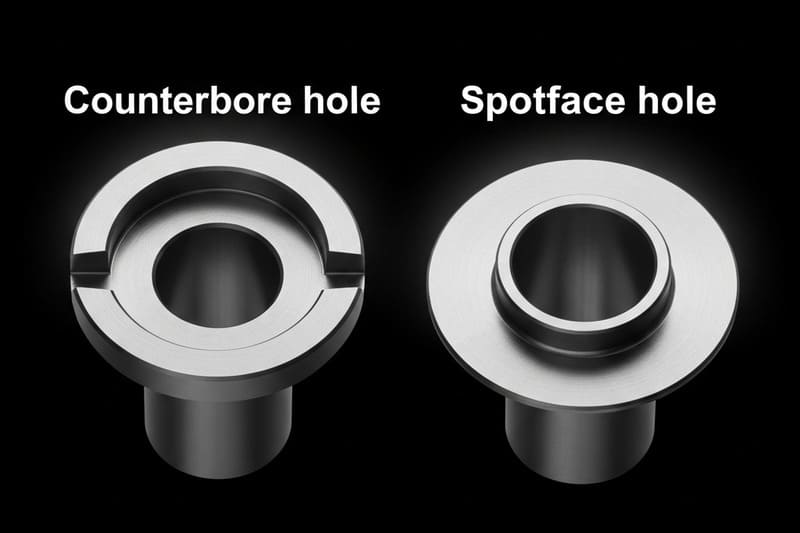
A spotface is a shallow circular recess machined around a hole’s opening to provide a flat surface for bolt heads or washers, particularly useful on rough or uneven materials like castings or forgings.

Dive Deeper: Why Spotfaces Matter in Machined Assemblies
Unlike counterbores, which are designed to recess fastener heads below the surface, spotfaces are intended solely to create a smooth, perpendicular seating plane. This becomes critical in ensuring uniform clamping pressure and load distribution, particularly in parts produced via processes that inherently generate uneven surfaces (e.g., sand casting or die casting).
Here’s how a spotface typically fits into the broader assembly design:
- Location: Spotfaces are concentric with the hole they surround and usually only a few millimeters deep (typically 0.5–1.0 mm).
- Tooling: They’re produced with spotfacing cutters or end mills. If precise diameter or surface finish is required, custom cutters may be used.
- Dimensions: The diameter is generally just larger than the fastener’s bearing surface (bolt head or washer). This avoids excessive material removal and machining time.
When Do You Need a Spotface?
| Condition | Reason for Spotface |
|---|---|
| Uneven surface (cast or forged) | Creates flat, perpendicular bolt seating area |
| Load-bearing joint | Ensures even load transfer and prevents bolt loosening |
| Washer or gasket used | Improves seal integrity and bolt alignment |
| Critical sealing surfaces | Reduces leakage and improves mechanical sealing |
Design Considerations
- Spotface diameter should be slightly larger than the bolt head or washer.
- Too deep a spotface may unnecessarily weaken the material or add cost.
- If GD&T is used, the flatness and perpendicularity of the spotface may require tolerancing.
In practice, spotfaces provide a simple, low-cost enhancement that greatly improves joint reliability—especially when dealing with non-machined surfaces. They’re especially common in heavy equipment, automotive castings, fluid system flanges, and gearbox assemblies where robust mechanical performance is required.
What Is a Counterbore?
Fastener heads sticking out can interfere with mating parts or moving components. A counterbore is the solution for flush or recessed bolt installations.
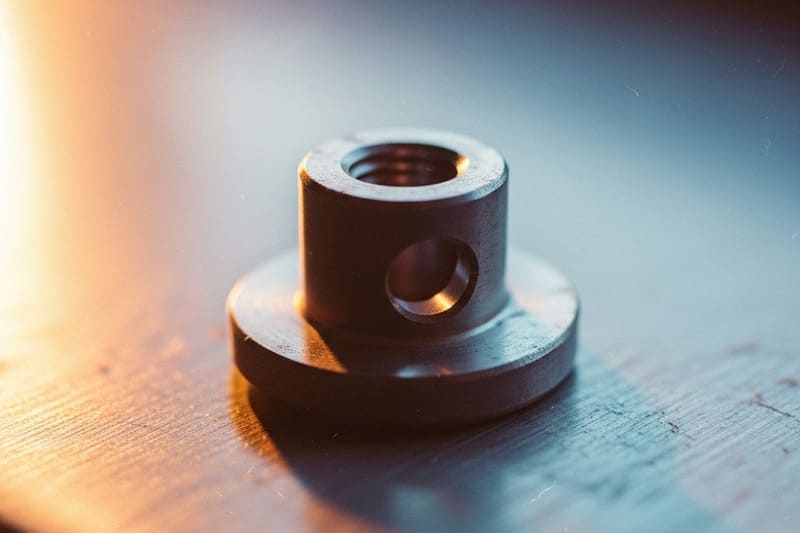
A counterbore is a cylindrical, flat-bottomed recess machined around a hole to house the head of a fastener—allowing it to sit flush with or below the surface of the part.
Dive Deeper: Functionality and Form of a Counterbore
Unlike spotfaces, which are shallow and mainly provide a flat seating area, counterbores are deeper features designed to contain the full head of a bolt or screw. This is especially important when aesthetics, clearance, or assembly precision are involved.
Counterbores are often used for socket head cap screws or hex bolts, particularly in applications where multiple components are stacked or where fasteners should not protrude and interfere with adjacent parts. Their consistent depth and diameter allow for precise load transfer and aesthetic integration in product assemblies.
Key Characteristics of a Counterbore
- Depth: Typically equals the height of the fastener head, with an additional clearance allowance (e.g., +0.5 mm).
- Diameter: Matches or slightly exceeds the outer diameter of the fastener head.
- Machining: Created using specialized counterbore cutters, boring bars, or end mills on CNC machines.
- Symbol: ⌴ on engineering drawings, often accompanied by depth and diameter annotations.
When to Use a Counterbore?
| Application Scenario | Reason to Use Counterbore |
|---|---|
| Flush or hidden fastener installation | Prevents bolt heads from interfering with mating surfaces |
| Rotating or sliding parts near bolts | Avoids contact and damage to adjacent moving parts |
| Clean aesthetics or product design | Maintains sleek visual appearance |
| Stacked part assemblies | Ensures flush fit across joined components |
Design Considerations for Counterbores
- Always specify diameter and depth clearly in the technical drawing.
- Avoid unnecessarily deep counterbores as they remove more material and increase cycle time.
- Use standard dimensions aligned with fastener sizes (e.g., ISO or ANSI cap screws).
- Consider adding a tolerance block or GD&T callouts if precise fit is critical to function.
Counterbores are essential for flush assembly, especially in electronics, aerospace, robotics, and consumer products. Properly applied, they support both functional performance and refined appearance, making them indispensable in modern CNC design and manufacturing workflows.
Spotface vs. Counterbore: Side-by-Side Comparison
Spotfaces and counterbores look similar—but choosing the wrong one can result in higher costs, poor assembly, or part failure.

Here’s a direct comparison of spotface and counterbore features to help you choose the right solution for your design and manufacturing needs.
Dive Deeper: Key Differences at a Glance
| Feature | Spotface | Counterbore |
|---|---|---|
| Purpose | Provide a flat seating surface on uneven materials | Allow fastener heads to sit flush or below the surface |
| Depth | Shallow (0.5–1.0 mm) | Deeper (typically equal to fastener head height) |
| Appearance | Flat, ring-shaped recess with minimal depth | Deep, cylindrical recess concentric with a hole |
| Tooling | Spotfacing tools or end mills | Counterbore tools, boring bars, or end mills |
| Primary Function | Normalize bolt seating surface | Hide or recess fastener heads for function or aesthetics |
| Common Use | On rough surfaces (castings, forgings) | In assemblies needing flush heads or clearance |
| Standards | ASME Y14.5, ISO 6411 | ASME B18.6.3, ISO 15065 |
| Drawing Symbol | ⌴ with callout (often no depth specified) | ⌴ with both diameter and depth dimensions |
Which One Should You Use?
- Choose a spotface: When your goal is to flatten an irregular surface for proper bolt load distribution.
- Choose a counterbore: When your fastener needs to be recessed, flush with the part surface, or hidden from sight.
Summary
The difference between a spotface and a counterbore is more than just depth—it’s about purpose. A spotface is a subtle touch for fit and function. A counterbore is a structural feature that affects assembly and visual finish. Use each strategically to balance manufacturing cost, mechanical performance, and product aesthetics.
When to Use Each?
Choosing between a spotface and a counterbore isn’t always intuitive—but picking the wrong one can affect assembly, durability, and cost.
Spotfaces and counterbores serve different engineering purposes. Here’s how to determine which is right based on your specific design requirements.
Dive Deeper: Choosing the Right Feature for the Job
When to Use a Spotface
- Surface Irregularity Exists: Use spotfaces when mounting to rough surfaces like castings, forgings, or weldments. They create a flat bolt seat even when the surrounding area isn’t smooth.
- Minimal Material Removal Is Needed: Spotfacing removes very little material, which is ideal for thin walls or lightweight designs.
- No Need for Recessing: If bolt or washer heads do not need to sit below the surface, a spotface is sufficient.
- Load Distribution Matters: Spotfaces help spread clamping force evenly and prevent stress concentrations that can crack parts or cause leaks in sealing applications.
When to Use a Counterbore
- Fastener Must Sit Flush or Hidden: Use counterbores when the bolt head needs to be recessed for clearance, aesthetics, or protection from external contact.
- Stacked Assemblies or Covers: If multiple components are bolted together or must sit flush (e.g., enclosure lids), counterbores keep the assembly flat and clean.
- High-Speed or Moving Interfaces: In situations where protruding bolts could interfere with rotating or sliding parts, counterbores eliminate that risk.
- Tool Clearance or Safety Requirements: If tools or hands pass over the surface, hiding bolt heads inside counterbores helps avoid snags or accidents.
Quick Comparison
| Design Goal | Recommended Feature |
|---|---|
| Level bolt seating on rough surface | Spotface |
| Hide fastener heads for appearance | Counterbore |
| Minimize material removal | Spotface |
| Flush assembly for covers or housings | Counterbore |
| Avoid interference with moving parts | Counterbore |
| Add bolt clearance on curved/irregular surface | Spotface |
Final Advice
Spotfaces are about functional leveling; counterbores are about clearance and visual finish. Don’t treat them interchangeably—each is purpose-built for specific mechanical and assembly needs. A well-placed hole feature ensures bolts do their job safely, efficiently, and aesthetically.
Machining & Design Considerations?
Getting the hole type right is only half the battle—understanding how to machine it efficiently and specify it correctly in design files is just as critical.
Spotfaces and counterbores have different tolerancing, tooling, and manufacturability requirements. Here’s what you need to keep in mind when designing parts with these features.
Dive Deeper: Engineering Smarter Features
Tolerancing and GD&T
Spotfaces typically have looser tolerancing because their purpose is simply to level an uneven surface. A depth tolerance of ±0.2 mm is often acceptable. However, counterbores usually require tighter tolerances—especially for critical depth or alignment in stacked assemblies. Tolerances like ±0.05 mm may be needed to ensure bolt heads sit properly and don’t interfere with mating parts.
Use symbols (per ASME Y14.5) with complete dimensioning: depth, diameter, and positional tolerances if necessary. Don’t forget to include thread callouts or clearance hole specs in the drawing.
Tooling Selection
Both spotfaces and counterbores can be machined using CNC mills, but tool choice affects cycle time and surface finish:

- Spotfaces: Best achieved with a spotfacing cutter or flat-bottom end mill. For small batch jobs, standard end mills are usually sufficient.
- Counterbores: Dedicated counterbore tools or boring bars provide superior accuracy and finish. Indexable tools may be needed for larger diameters or production runs.
Use rigid setups and minimize tool stickout to avoid chatter, especially in deep counterbores.
Production Efficiency
In production environments, every toolpath counts. Spotfaces are faster to machine because they require minimal depth and smaller diameter tools. Counterbores demand deeper cuts and often slower feeds to maintain flat-bottom accuracy. Multiple depths or large diameters further increase machining time.
If the functional requirement doesn’t justify a counterbore, choosing a spotface can save several minutes per part—multiplied across hundreds or thousands of units.
Design File Clarity
Ambiguous or incomplete callouts are a top cause of machining errors. Always include the following in your 2D drawing or 3D CAD model:
- Hole diameter and depth (including counterbore or spotface size)
- Thread specifications if applicable
- Fastener type and head dimensions
- Surface finish callouts (especially for sealing interfaces)
Avoid These Mistakes
- Over-specifying tolerances: Don’t apply ±0.01 mm everywhere—only where it’s truly needed
- Using counterbores unnecessarily: It drives up machining cost and complexity
- Not planning for tool access: Ensure the fixture and part design allow room for machining the feature cleanly
Quick Summary Table
| Factor | Spotface | Counterbore |
|---|---|---|
| Machining Time | Short | Longer |
| Required Tolerances | Loose | Tight |
| Tooling Complexity | Simple | Moderate to Complex |
| Application Sensitivity | Low | High |
| CAD Clarity Importance | Medium | High |
Final Word
Designing effective spotfaces and counterbores isn’t just about function—it’s about optimizing for manufacturability. The more precisely you define your hole features and tolerances, the smoother your part moves from CAD to finished product.
Common Mistakes to Avoid?
Spotface and counterbore features may seem simple, but incorrect design or application can lead to poor fit, unnecessary cost, or functional failures.
Here are some of the most frequent mistakes engineers and machinists make—and how to avoid them when incorporating these features into your CNC designs.
Dive Deeper: Design Smarter, Machine Faster
1. Overdesigning with Counterbores
One of the most common errors is defaulting to counterbores in every bolted joint, especially when a spotface would suffice. Counterbores require more machining time, deeper material removal, and tighter tolerances. If the goal is simply to provide a flat seating surface on a cast or uneven face, a spotface is faster and cheaper to machine.
2. Underspecifying Drawing Details
Ambiguity in 2D drawings leads to shop floor confusion. Always clearly call out:
- Diameter and depth of the counterbore or spotface
- Fastener size and head type
- Surface finish (especially if sealing or mating parts are involved)
Don’t assume the machinist will “know” the intent—define it clearly in your CAD or technical drawing.
3. Ignoring Surface Conditions
Spotfaces are vital on rough or non-uniform surfaces like castings or forgings. Neglecting to add a spotface under bolt heads can lead to uneven load distribution, gasket leaks, or premature fastener failure. Always assess the finish and flatness of the material before deciding whether to include a spotface.
4. Applying Unnecessary Tight Tolerances
It’s tempting to assign ±0.01 mm to every hole feature—but it’s a costly habit. Spotfaces can often tolerate ±0.1 to ±0.2 mm depth variation. Counterbores may need precision, but only in critical assemblies. Be strategic with your tolerances to avoid inflated quotes and scrap due to minor non-conformance.
5. Overlapping with Threads or Chamfers
Designers occasionally place counterbores too close to tapped holes or forget to allow proper thread runout. This can lead to:
- Tool collisions during machining
- Weakened hole edges or thread engagement
- Galling or interference between fastener and wall
Make sure the counterbore depth and diameter allow enough clearance for tool entry and the full thread length below.
6. Using Inappropriate Tooling
Using standard drill bits to create spotfaces or counterbores may result in a poor finish, chatter, or off-center holes. Always use the right tool for the feature—like a counterbore cutter with a pilot, or a flat-bottom end mill for manual CNC control. This helps ensure concentricity and improves repeatability.

Quick Reference: Mistake Impact Table
| Mistake | Impact | Solution |
|---|---|---|
| Overdesigning with counterbores | Increased cycle time and cost | Use spotface if bolt head does not need to be recessed |
| Missing dimensional callouts | Delayed production, rework | Specify diameter, depth, and fastener size in drawings |
| Skipping spotfaces on rough surfaces | Uneven load transfer, sealing issues | Always add spotface to cast/forged bolt seats |
| Overly tight tolerances | Higher cost, unnecessary rejects | Apply tight tolerances only where functionally necessary |
| Design interference with threads | Assembly issues or tool collision | Check clearance, maintain thread engagement |
| Wrong tooling method | Poor finish, concentricity errors | Use dedicated spotface/counterbore tools |
Final Word
Designing effective bolt interfaces isn’t about over-engineering—it’s about knowing when to keep it simple. Avoiding these common mistakes will streamline your machining process, reduce costs, and improve the performance of your mechanical assemblies.
Real-World Use Cases?
While spotfaces and counterbores are essential hole features in theory, their real value shines in actual industrial applications. The way engineers deploy these design elements depends heavily on the performance demands, assembly method, and materials of a product.
This section showcases specific industry use cases where spotfaces and counterbores play critical roles in ensuring reliable fastening, sealing, and alignment.
Dive Deeper: When and Where to Apply Spotfaces and Counterbores
Aerospace: Spotfaces for Uniform Load Distribution
In aircraft components such as turbine housings or landing gear brackets, engineers often work with cast or forged metals. These raw materials can have rough, uneven surfaces that compromise the seating of fasteners. A spotface is applied beneath bolt heads to create a consistent contact area and ensure proper torque transmission.
Even a slight tilt in bolt seating due to irregular casting can result in stress risers or leak paths in pressurized assemblies. Spotfacing neutralizes this risk without significantly increasing machining time or cost.
Automotive: Counterbores in Engine Assemblies
Engine covers, transmission housings, and suspension brackets often require flush bolt heads for space-saving and vibration-resistant design. Counterbores are used to embed fastener heads below the surface to allow space for rotating components or to create a smooth, non-obtrusive finish.
For instance, counterbored socket head cap screws keep critical assemblies compact and enable tight packaging within engine compartments without compromising accessibility or safety.
Robotics & Automation: Precision Mounting with Counterbores
In robotic arms or precision automation tooling, parts must align with micron-level repeatability. Counterbores are often applied to ensure that bolted joints do not interfere with adjacent motion paths or fixtures. Cap screws sit flush inside brackets or mounting plates, preserving a sleek, snag-free profile essential in dynamic systems.
Industrial Valves: Spotfaces for Sealing Reliability
Valve bodies, especially those involved in fluid or gas sealing, rely heavily on uniform bolt load distribution. Spotfaces under flange bolts ensure that the gasket compresses evenly, reducing the likelihood of leaks over time. Since many valve bodies are cast or forged, spotfacing ensures functional integrity with minimal post-processing.

Medical Devices: Aesthetic and Functional Counterbores
In high-end surgical instruments or diagnostic equipment enclosures, the appearance of hardware matters just as much as performance. Designers often specify counterbores to hide screw heads beneath sleek surfaces, improving both hygiene (by eliminating crevices) and aesthetics.
Application Summary Table
| Industry | Component | Feature Used | Why It Matters |
|---|---|---|---|
| Aerospace | Turbine housings, landing gear brackets | Spotface | Ensures flat seating on cast surfaces |
| Automotive | Engine covers, gearboxes | Counterbore | Flush fastener heads reduce interference |
| Robotics | Actuator mounts, tooling arms | Counterbore | Streamlined profile prevents collision |
| Industrial Equipment | Valve flanges, pressure housings | Spotface | Supports sealing and bolt load balance |
| Medical Devices | Instrument covers, diagnostic panels | Counterbore | Flush design for aesthetics and hygiene |
Final Word
Whether you’re designing for high-pressure sealing, clean industrial aesthetics, or complex motion systems, choosing the right hole feature makes a big difference. Real-world examples show that spotfaces and counterbores are more than just machining features — they’re functional design tools that elevate the quality and reliability of your assemblies.
Conclusion
Choosing between a spotface and a counterbore isn’t just a cosmetic decision — it’s about mechanical integrity, performance, and manufacturing efficiency.
Spotfaces are ideal when you need a flat surface for bolt seating, particularly on rough or uneven materials like castings. They ensure load is distributed evenly and are fast and economical to machine. On the other hand, counterbores offer a flush or recessed fastener finish, which is essential in applications with limited clearance, aesthetics concerns, or stacked assemblies.
Recap of Key Takeaways
- Spotface: Minimal material removal, improves bolt seating, especially on rough surfaces
- Counterbore: Recessed head seating for fasteners, used where flush finish or clearance is required
- Design wisely: Choose based on functional needs, cost-efficiency, and part geometry
- Avoid overengineering: Don’t apply counterbores when spotfaces will do the job
- Manufacture smart: Include precise hole dimensions, depths, and tolerances in your technical drawings
Final Thoughts
Every machined hole plays a structural and functional role in your assembly — and misusing a spotface or counterbore can create alignment issues, fastener failures, or unnecessary cost overruns. At Onlyindustries, we work closely with mechanical designers and engineers to ensure that each hole feature is applied with the right intention, tools, and tolerance.
Let us help you optimize your part geometry for both performance and manufacturability. Whether you need high-precision counterbores for an aerospace housing or fast spotfacing for valve components, we’ve got the expertise to make it happen.
Contact Onlyindustries today and get expert guidance on designing for bolted joint integrity and machining efficiency.
Why Work With Onlyindustries?
In precision machining, experience matters — but so does alignment with your goals. You need more than a manufacturer; you need a partner who understands tolerances, finishes, deadlines, and how to bring your designs to life without compromise.
At Onlyindustries, we specialize in solving the real-world challenges that come with CNC machined parts — from feature tolerancing and material selection to optimal hole preparation with spotfaces, counterbores, and beyond.
Expertise Meets Practicality
We don’t just “machine what’s on the print.” We review your drawings and models through a design-for-manufacturability (DFM) lens — identifying cost-saving improvements, tooling-friendly tweaks, and ways to eliminate rework or delays. Whether you need a single prototype or a high-volume production run, our engineers apply their machining knowledge to protect your timeline and budget.
Specialized in Spotfaces & Counterbores
| Service | Benefit |
|---|---|
| Spotface Optimization | Flat bolt seating surfaces on cast or forged parts for load consistency |
| Precision Counterbores | Flush or recessed fastener fit for tight assemblies and clean finishes |
| Hole Feature Consultation | Recommendations on fastener type, clearance, depth, and tolerancing |
| GD&T Expertise | Correct callouts for concentricity, perpendicularity, and surface flatness |
Global Clients, Local Support
Whether you’re a product design firm in Europe or a medical device OEM in North America, our production and support teams are built for global delivery with local responsiveness. Our lead times are competitive, our machining tolerances are tight, and our communication is crystal clear — from RFQ to final inspection.
Let’s Build It Right the First Time
- Custom fixturing and workholding for complex parts
- Surface finishing including anodizing, passivation, and powder coating
- Support for AS9100, ISO 13485, and tight-tolerance projects
- Rapid prototypes to production-scale manufacturing
Let’s collaborate. If you’re engineering a component that needs reliable bolt seating or flush fastener integration, Onlyindustries is your best bet for success — in form, function, and finish.