Skip to content
Drones, or unmanned aerial vehicles (UAVs), have revolutionized industries ranging from defense and agriculture to photography and logistics. As demand rises, manufacturers must optimize design, material selection, production methods, and cost efficiency. This guide offers a comprehensive look at drone manufacturing from the perspective of materials, manufacturing processes, and cost considerations.
What Is Drone Manufacturing?
Drones are transforming industries—but how exactly are they made?
Drone manufacturing is the process of designing, engineering, assembling, and testing unmanned aerial vehicles (UAVs). These systems include everything from flight control electronics and propulsion systems to lightweight frames and sensor payloads. Whether you’re producing hobbyist quadcopters or industrial-grade drones, manufacturing requires precision, advanced materials, and streamlined production techniques.
Understanding drone manufacturing is key to optimizing weight, flight performance, cost-efficiency, and durability across industries like defense, agriculture, logistics, and photography.
Key Stages of Drone Manufacturing
- Design & Prototyping: Engineers create 3D CAD models and test early-stage prototypes using CNC machining or 3D printing.
- Material Selection: Lightweight yet strong materials such as carbon fiber, polycarbonate, or aluminum are chosen for different parts.
- Component Integration: Motors, propellers, sensors, GPS, batteries, and electronic speed controllers (ESCs) are integrated into the chassis.
- Manufacturing: Production methods vary—high-end drones often use CNC and carbon layups, while consumer models rely on injection molding and electronics assembly lines.
- Testing & Calibration: Quality control includes flight testing, ESC calibration, firmware updates, and stress testing of structural components.

Balancing Engineering Trade-offs
| Requirement | Design Challenge | Manufacturing Impact |
|---|---|---|
| Flight time | Reduce weight without compromising strength | Use carbon fiber, hollow aluminum, minimal fasteners |
| Durability | Withstand crashes, wind, or vibration | Reinforced frames, balanced rotors, CNC precision |
| Cost | Maintain affordability for target market | Leverage injection molding for high volume |
Industry-Specific Considerations
- Defense: Requires secure electronics, ruggedized housings, and autonomous flight capabilities.
- Agriculture: Needs long flight duration, weather resistance, and sprayer integration.
- Filmmaking: Prioritizes smooth gimbal mounts, low vibration, and low noise design.
In short, drone manufacturing is not just about building flying robots—it’s about integrating mechanical engineering, aerodynamics, electronics, and material science into a cohesive, functional product that meets real-world demands.
Key Manufacturing Processes in Drone Production
Producing high-performing drones requires combining advanced manufacturing methods with smart material use.
Drone production integrates several manufacturing techniques, each chosen based on volume, strength, design complexity, and cost efficiency. From prototyping to full-scale production, the method impacts everything from aerodynamics to part durability.
The key is selecting the right process for each component—from lightweight frames to precise motor housings—while balancing performance with budget and scalability.
1. Injection Molding
Injection molding is ideal for producing high volumes of plastic drone parts with consistent quality.
- Use Cases: Propellers, protective shells, landing gear, motor mounts
- Materials: ABS, polycarbonate, nylon
- Advantages: Scalable, cost-effective, repeatable
- Considerations: High upfront mold cost, design fixed after tooling
2. CNC Machining
CNC machining offers unmatched precision and strength, perfect for custom metal parts and structural elements.
- Use Cases: Motor brackets, gimbal mounts, camera supports
- Materials: Aluminum (6061/7075), titanium, steel
- Advantages: Tight tolerances, no mold needed, high structural integrity
- Considerations: Slower for large batches, more expensive per part
3. 3D Printing (Additive Manufacturing)
3D printing is the go-to method for prototyping and short-run custom drone components with complex geometries.
- Use Cases: Enclosures, brackets, airframe prototypes
- Materials: PLA, PETG, carbon-filled nylon, resins
- Advantages: Fast iteration, low tooling cost, great for custom builds
- Considerations: Limited strength, slower than molding or machining
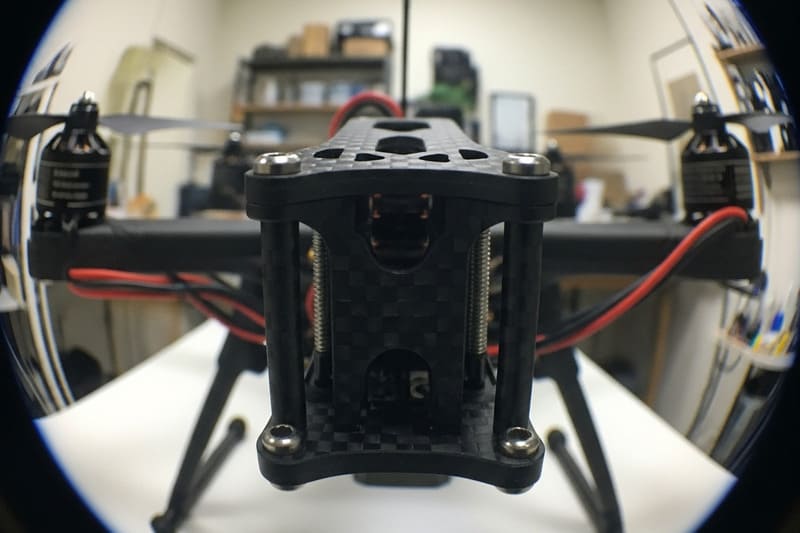
4. Carbon Fiber Layup
This process delivers high strength-to-weight ratios, essential for racing and professional drones.
- Use Cases: Main drone frames, rotor arms, chassis
- Materials: Carbon fiber sheets, epoxy resin
- Advantages: Lightweight, ultra-strong, fatigue-resistant
- Considerations: Labor-intensive, expensive, manual work often required
5. Sheet Metal Fabrication
Useful for structural and thermal management components that require moderate complexity and low to mid volume.
- Use Cases: Battery holders, brackets, motor covers, heat shields
- Materials: Aluminum, stainless steel
- Advantages: Fast turnaround, simple tooling, durable
- Considerations: Less suited for intricate 3D designs
Drone Part-to-Process Matching Table
| Part | Recommended Process | Material |
|---|---|---|
| Drone Frame | Carbon Fiber Layup | Carbon Fiber |
| Motor Mounts | CNC Machining | 7075 Aluminum |
| Propellers | Injection Molding | ABS |
| Battery Case | Sheet Metal | Stainless Steel |
| Sensor Housings | 3D Printing | PETG or Resin |
Choosing the correct process upfront helps reduce cost, simplify production, and improve drone performance. Whether scaling production or refining a prototype, the process you select plays a pivotal role in success.
Materials Commonly Used in Drone Manufacturing
Material choice is critical in drone design as it directly impacts flight performance, structural integrity, and production cost.
Lightweight, strong, and versatile materials are prioritized to balance durability with aerial efficiency.

The most commonly used materials in drone manufacturing vary based on component function and performance needs:
Overview of Common Materials
| Material | Application | Pros | Cons |
|---|---|---|---|
| ABS | Enclosures, propellers | Lightweight, moldable, low cost | Low heat resistance, brittle under stress |
| Nylon (PA) | Frames, gear housings | Tough, impact- and chemical-resistant | Moisture absorption can affect stability |
| Polycarbonate (PC) | Camera domes, motor guards | Excellent impact strength, clarity | Higher cost, prone to UV degradation |
| Aluminum (6061/7075) | Arms, brackets, motor mounts | Strong, corrosion-resistant, lightweight | More expensive than polymers, conductive |
| Carbon Fiber | Drone frames, rotor arms | Very strong, ultra-lightweight, high stiffness | Costly, brittle under impact, labor-intensive layup |
| Titanium | Hardware, payload supports | Corrosion-resistant, extremely strong | Very expensive, difficult to machine |
Dive Deeper: Strategic Material Choices
Every drone application has unique performance targets. The right material selection must balance:
- Weight-to-strength ratio – critical for extending flight time and battery life
- Environmental durability – such as UV resistance for outdoor flight or chemical resistance for agriculture
- Manufacturing method compatibility – e.g., ABS and nylon are ideal for injection molding; carbon fiber requires layup and curing
- Regulatory requirements – especially for drones used in defense, medical, or aerospace fields
Material Synergy in Design
Often, the best drones aren’t built from a single material but from a carefully engineered combination. For example:
- Carbon fiber frames with aluminum brackets allow a stiff yet shock-resistant build
- Nylon gearboxes inside ABS housings provide ruggedness and ease of assembly
- Polycarbonate domes paired with carbon fiber arms offer visibility and strength
At Onlyindustries, we advise on material selection based on application environment, flight performance goals, and unit economics. Whether prototyping or scaling, material choice is foundational to success.
Key Components of a Drone
Building a functional and reliable drone starts with understanding its critical components.
Each part plays a unique role—from maintaining flight stability to managing power and capturing data. Optimizing these elements ensures safety, performance, and mission readiness.
Let’s break down the essential drone parts and their primary functions:
Core Components and Their Roles
| Component | Function | Notes |
|---|---|---|
| Frame | Holds all other components; defines structure and size | Should be lightweight, rigid, and vibration-resistant |
| Motors | Drive the propellers for lift and maneuvering | Require precise balancing and cooling |
| Propellers | Generate lift and thrust | Must be aerodynamically designed and weight-matched |
| Electronic Speed Controllers (ESCs) | Regulate motor speed based on controller input | Should support real-time response and redundancy |
| Flight Controller | Acts as the drone’s “brain”; processes sensor data | Responsible for flight stabilization and navigation |
| Battery | Provides electrical power to the whole system | LiPo batteries are standard; tradeoff between weight and duration |
| Sensors | Enable autonomous flight and environmental awareness | Includes GPS, gyroscopes, accelerometers, altimeters |
| Payload | Tools for mission-specific use (e.g., camera, sprayer) | Can be swappable or fixed; affects balance and power |

Dive Deeper: System Integration & Performance
The synergy between drone components is just as important as the parts themselves. Here’s why:
- Weight Distribution: Improper weight balance affects flight time and control. Components must be symmetrically arranged.
- Vibration Isolation: High-RPM motors and propellers create vibrations that can disrupt sensor readings. Anti-vibration mounts or pads are often necessary.
- Modular Design: Components should be accessible and replaceable. This simplifies repairs and future upgrades.
- EMI Shielding: Flight controllers and ESCs must be shielded from electrical noise, especially when powerful motors are involved.
Example Component Configurations
Here’s how components vary by drone category:
- Racing drones: Emphasize small frames, lightweight propellers, and high-RPM motors
- Surveying drones: Use large batteries, dual GPS modules, and high-resolution cameras
- Delivery drones: Include heavier-duty motors, durable frames, and smart ESCs with redundancy
At Onlyindustries, we machine and assemble components to your exact tolerance and layout needs—ensuring seamless performance in the air. From motor mounts to battery enclosures, every part is built with your application in mind.
Cost Factors in Drone Manufacturing
Drone manufacturing costs vary widely depending on design complexity, materials, and production scale.

By understanding what drives pricing, manufacturers can make smart trade-offs between performance and affordability.
Here’s a breakdown of the primary cost influencers in drone production:
Major Cost Drivers
| Factor | Description | Cost Impact |
|---|---|---|
| Material Selection | Choice of plastic, metal, or composites | Carbon fiber and titanium significantly increase cost |
| Production Volume | Number of units per batch or series | Larger volumes lower per-unit price due to economies of scale |
| Precision Requirements | Tight tolerances or custom-machined parts | Increases machining time and inspection effort |
| Tooling Investment | Cost of injection mold or stamping die setup | High upfront cost, amortized over production run |
| Electronics & Sensors | GPS, IMU, cameras, flight controller | Often the most expensive sub-system |
| Labor & Assembly | Manual tasks like soldering, carbon layup, wiring | Increases with customization or low automation |
| Compliance Testing | Includes CE, FCC, FAA, and stress testing | Mandatory for drones used in regulated industries |
Sample Cost Breakdown
For a mid-range commercial drone (~$800 USD), the typical cost allocation might look like this:
| Category | % of Total Cost |
|---|---|
| Electronics & Sensors | 35% |
| Mechanical Structure | 25% |
| Power System | 15% |
| Labor | 15% |
| Testing & QA | 10% |
Dive Deeper: Optimizing for Cost Without Sacrificing Quality
To keep costs manageable without compromising performance, I follow several best practices:
- Modular Design: Enables the reuse of components across multiple drone models.
- Material Substitution: Replace carbon fiber with glass-filled nylon where high strength isn’t critical.
- Batch Production: Consolidating production reduces labor overhead and improves tooling efficiency.
- Design for Assembly: Fewer screws and snap-fit joints save time and money on the assembly line.
- Supplier Partnerships: Long-term contracts lower part costs and improve lead times.
Onlyindustries supports both prototype and production scaling. Whether you’re testing a concept or launching full production, we help optimize cost and performance with smart material selection and advanced manufacturing techniques.
Prototype vs. Mass Production
Choosing between prototyping and mass production impacts everything from material selection to tooling strategy and delivery timelines.

Understanding when and how to switch from prototype to scaled production can save time, money, and risk in drone development.
Here’s how I approach both phases strategically depending on the stage of product development:
Prototype Phase
| Aspect | Details |
|---|---|
| Methods | 3D Printing, CNC Machining, Manual Assembly |
| Focus | Design validation, functional testing, mechanical fitting |
| Volume | 1–10 units typically |
| Turnaround Time | Fast iteration (within days) |
| Cost | Higher per-unit cost due to manual labor and no tooling amortization |
Mass Production Phase
| Aspect | Details |
|---|---|
| Methods | Injection Molding, Die Casting, Sheet Metal Stamping |
| Focus | Efficiency, consistency, cost reduction |
| Volume | 100–10,000+ units |
| Tooling | High upfront cost but amortized over volume |
| Lead Time | Longer setup but lower per-unit cost once running |
Dive Deeper: My Transition Strategy
Here’s how I usually manage the transition from prototype to production to maximize output and ROI:
- Phase 1 – Prototyping: Validate the drone’s structure, propulsion, and payloads using CNC aluminum mounts and 3D printed frames.
- Phase 2 – Pre-Production: Use hybrid methods—off-the-shelf ESCs and machined brackets while testing mold designs.
- Phase 3 – Mass Production: Finalize injection molds, streamline electronics BOM, and set up jigs for semi-automated assembly.
At Onlyindustries, we support this full cycle—from fast 3D-printed prototypes to precision-machined short runs, all the way to high-volume mold-based production with ISO quality compliance.
Drone Applications Across Industries
Drones are no longer niche gadgets—they’re vital tools across industries. Each sector has unique requirements for endurance, payload, and sensor integration.
Industrial drones are transforming inspection, delivery, surveillance, and data collection with speed and precision that ground-based systems can’t match.

Agriculture
In precision agriculture, drones enhance crop health monitoring, irrigation management, and pesticide application.
- Use Cases: NDVI imaging, multispectral surveys, and aerial spraying
- Value: Increases yield while reducing labor and chemical usage
Defense & Security
Military and homeland security sectors rely on UAVs for intelligence gathering, search and rescue, and combat support.
- Use Cases: Reconnaissance, border patrol, target acquisition
- Value: Keeps personnel out of harm’s way while enhancing situational awareness
Logistics & Delivery
Delivery drones are revolutionizing last-mile fulfillment in both urban and remote areas.
- Use Cases: Parcel drop-offs, warehouse inventory checks
- Value: Faster delivery, reduced traffic congestion, and fewer emissions
Photography & Film
Aerial drones allow for dynamic, stabilized footage previously only possible with helicopters or cranes.
- Use Cases: Movie shoots, weddings, real estate promotions
- Value: Captures cinematic perspectives at a fraction of traditional costs
Surveying & Mapping
Drones streamline land development, mining exploration, and civil engineering by creating precise 2D/3D maps.
- Use Cases: Orthophotos, LiDAR topography, volumetric analysis
- Value: Reduces field time and enhances accuracy
Infrastructure Inspection
Hard-to-reach or hazardous infrastructure can be safely inspected by UAVs equipped with high-resolution cameras and sensors.
- Use Cases: Wind turbine blade checks, power line analysis, bridge integrity scans
- Value: Minimizes downtime, improves safety, and saves cost
Dive Deeper: Matching Specs to Industry Needs
When I support drone builds for industry-specific needs, here’s my rule of thumb:
| Industry | Key Requirement | Engineering Focus |
|---|---|---|
| Agriculture | Long flight time, payload for spraying | Light frame, large battery capacity |
| Defense | Stealth, ruggedness | Carbon fiber body, encrypted controls |
| Surveying | Sensor stability | Vibration dampening and GPS sync |
| Logistics | Load capacity, modularity | Foldable arms, quick-swap batteries |
At Onlyindustries, we machine and assemble precision drone components tailored to the demands of your sector—whether it’s lightweight titanium arms for rugged field work or polished mounts for consumer-facing gimbal systems.
Best Practices for Drone Manufacturing
Even the most innovative drone designs can fall short without proper manufacturing strategy. Addressing performance, longevity, and serviceability early in production ensures drones meet both user expectations and compliance standards.

These best practices help create airworthy drones that are scalable, serviceable, and efficient—critical in today’s fast-evolving UAV market.
Choose the Right Frame Materials
Lightweight frames improve flight time and maneuverability, but strength is still vital—especially for drones carrying payloads or operating in rugged conditions.
- Use carbon fiber for high-strength, low-weight applications like racing or professional filming drones
- Use aluminum or magnesium alloy for precision brackets and rigid enclosures
- Use injection-molded ABS or nylon for cost-effective consumer models
Ensure Propeller and Rotor Balance
Unbalanced rotors can cause vibration, reduce sensor accuracy, and wear out motors prematurely.
- Use automated balancing rigs or software-aligned calibration before final assembly
- Inspect each blade and prop hub for damage, weight variance, or uneven mold fills
Design for Modularity
Modular drone architecture enables quick replacement of damaged parts and easier upgrades down the road.
- Use standard connectors for ESCs, sensors, and GPS units
- Design detachable arms and payload bays to reduce repair time
- Separate electronics and battery compartments for better heat and EMI management
Validate Thermal & EMI Shielding
Heat buildup and signal interference can cripple performance, especially in high-frequency sensor setups or dense component clusters.
- Add heat sinks to processors, ESCs, and high-output LEDs
- Shield sensitive circuits using metal enclosures or EMI gaskets
- Separate power and signal cables to prevent cross-talk
Standardize and Label Components
Component standardization simplifies logistics, reduces assembly error, and eases post-sale service.
- Label all wiring harnesses for polarity, voltage, and destination
- Use standard screw sizes and head types across modules
- Consolidate screws, nuts, and clips to minimize inventory SKUs
Dive Deeper: My Go-To Quality Checklist
When I prep a batch of drone components for final assembly, I walk through this checklist:
| Step | Why It Matters | Tool Used |
|---|---|---|
| Rotor Balance Test | Prevents long-term motor damage | Dynamic balancer |
| Thermal Load Simulation | Verifies safe temp zones for ESCs | IR camera + airflow chamber |
| EMI Scan | Ensures stable sensor and GPS performance | EM field scanner |
| Assembly Torque Validation | Prevents structural failures | Digital torque screwdriver |
At Onlyindustries, we don’t just machine parts—we engineer outcomes. Every bracket, rotor mount, and fastener is optimized not just for geometry, but for the realities of flight.
Why Choose Onlyindustries for Drone Component Manufacturing?
Finding a reliable manufacturing partner can make or break your drone program. From prototyping to full-scale production, Onlyindustries brings deep technical expertise, precision tooling, and agile operations that match the speed of innovation in the drone industry.
Here’s why I confidently recommend Onlyindustries to engineers, product managers, and drone startups who need more than just parts—they need performance, consistency, and real support.
Precision Machining Built for Aerospace Standards
We understand the tolerances drone systems demand. Whether it’s a lightweight motor mount or a load-bearing arm for a delivery drone, our CNC machining centers hold tolerances down to ±0.005 mm.
- High-precision 3-axis and 5-axis CNC machining
- Surface finishes optimized for aerodynamic profiles
- Capability with complex geometries and internal channels
Materials Expertise Tailored to Drone Applications
Every drone platform has its own constraints—flight time, durability, regulatory compliance. We machine and process materials that match those demands:
- 7075 aluminum: Ideal for high-load arms and brackets
- Carbon fiber composites: Layup support and CNC trimming
- Titanium: For ultra-lightweight, high-strength custom hardware
Fast Prototyping & Scalable Production
We help startups and established OEMs move from napkin sketch to first flight faster than you’d expect. Our integrated workshop reduces handoffs and lead time.
- Prototypes delivered in as little as 7 days
- Sample batch production within 45 days
- Mass production ramps up in 60–70 days
Quality You Can Fly With
Every component we ship undergoes documented inspection and rigorous dimensional checks.
- ISO 9001 and AS9100 quality management system compliance
- First Article Inspection (FAI) and PPAP support
- Custom packaging solutions to prevent damage during shipment
Global Experience, Local Responsiveness
Whether you’re launching a commercial UAV in Europe or scaling an agricultural drone fleet in Southeast Asia, our logistics and support teams deliver fast, clear communication across time zones and languages.
From My Experience
I’ve worked with manufacturers who treat drone components like basic brackets. Onlyindustries is different. They ask the right questions about thermal expansion, in-flight vibration, and sensor mounting alignment. That attention to detail saved me from costly revisions more than once.
Summary Comparison
| Capability | Onlyindustries | Typical Vendor |
|---|---|---|
| Material Flexibility | Aluminum, carbon fiber, titanium | Aluminum only |
| Turnaround Time | 7–14 days prototype | 3–5 weeks |
| Quality Control | FAI, ISO, PPAP, custom testing | Basic dimensional check |
| Engineering Support | DFM, tolerance tuning, vibration consulting | Minimal |
Choosing Onlyindustries means building smarter, lighter, and more reliable drones—without manufacturing headaches. When performance matters and timelines are tight, they deliver.
Conclusion
Drone manufacturing isn’t just about assembling parts—it’s about engineering for flight, efficiency, and precision at scale. From the initial design concept to final delivery, every choice—from materials and production methods to tolerances and testing—can impact the drone’s performance, cost, and market viability.
In my experience, the most successful drone projects are built on strong supplier partnerships. By leveraging precision processes like CNC machining and additive manufacturing, and aligning with vendors who understand lightweight materials, tight tolerances, and aerospace-level quality control, manufacturers gain more than components—they gain reliability, repeatability, and speed.
Whether you’re building drones for agriculture, defense, logistics, or aerial cinematography, it’s clear: success starts with strategic manufacturing. The right combination of materials, methods, and suppliers will not only get your UAVs off the ground—it will keep them flying longer, safer, and smarter.